The best soccer player of each decade, told through the World Cup
Spain beat Argentina 1-0 after extra time in the 2026 World Cup final at MetLife Stadium on July 19, 2026, and with that result the 2020s ran out of men's World Cups. The next one is in 2030. Six weeks later, on August 31, Lionel Messi announced his retirement from international football. The decade he shared with Kylian Mbappé now has its final numbers.
Those numbers let us do something that was not possible a year ago. Every decade since the 1920s is now closed as far as the men's World Cup is concerned, so each one can be judged as finished work. We went through all of them and chose one player per decade, with the World Cup as the main evidence. Here is the full list before the arguments.
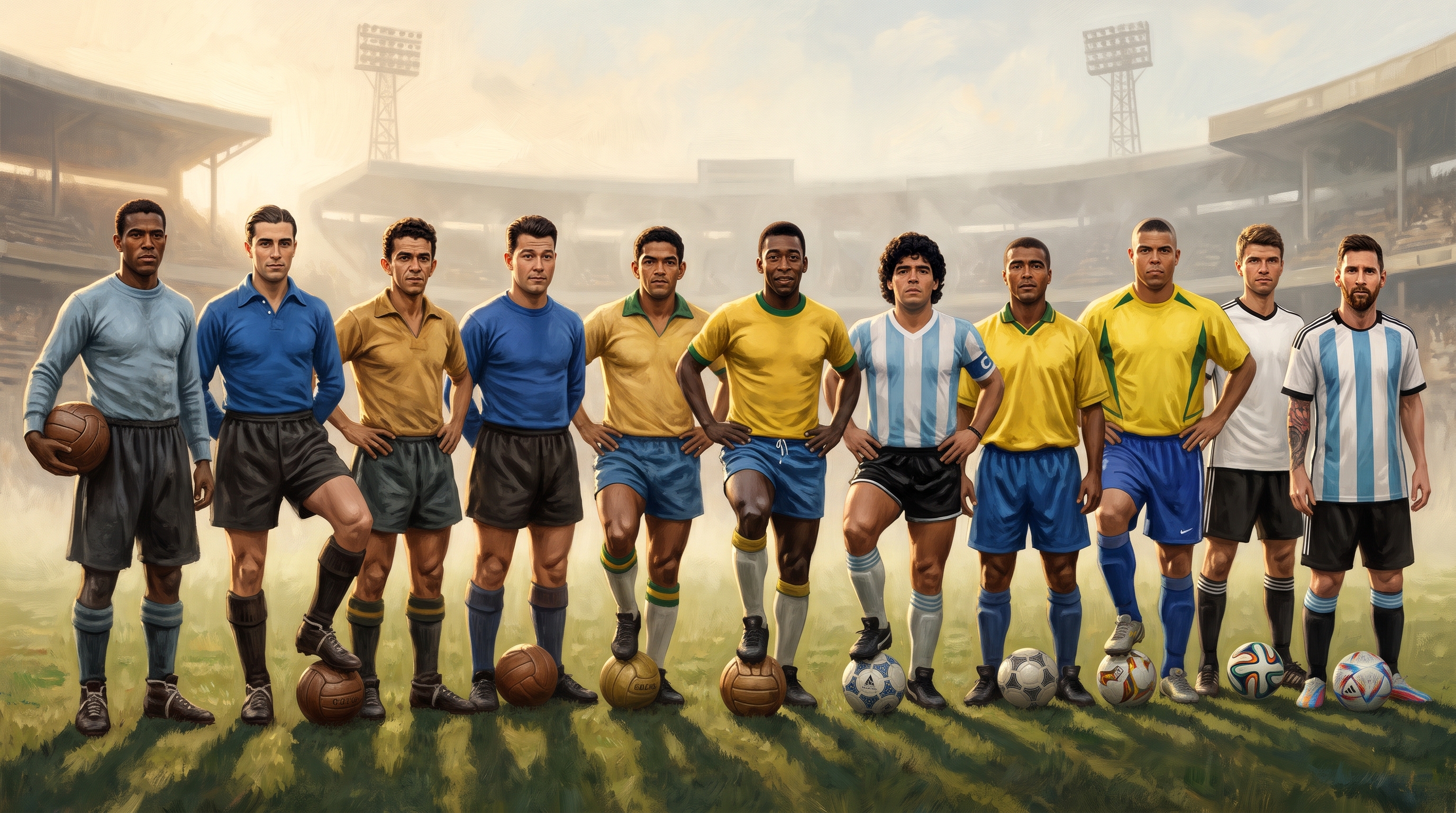
| Decade | Our pick | Nation | World Cups played | What decided it |
|---|---|---|---|---|
| 1920s | José Leandro Andrade | Uruguay | 1930 | Olympic gold in 1924 and 1928, then the first World Cup |
| 1930s | Giuseppe Meazza | Italy | 1934, 1938 | Two world titles |
| 1940s | Zizinho | Brazil | 1950 | Best player of the 1950 tournament |
| 1950s | Just Fontaine | France | 1958 | 13 goals in one World Cup, still the record |
| 1960s | Garrincha | Brazil | 1958, 1962, 1966 | Won the 1962 title with Pelé injured |
| 1970s | Pelé | Brazil | 1958, 1962, 1966, 1970 | Mexico 1970 and a third title |
| 1980s | Diego Maradona | Argentina | 1982, 1986, 1990, 1994 | Mexico 1986 |
| 1990s | Romário | Brazil | 1990, 1994 | Title and Golden Ball in 1994 |
| 2000s | Ronaldo | Brazil | 1998, 2002, 2006 | 8 goals and the title in 2002 |
| 2010s | Thomas Müller | Germany | 2010, 2014, 2018, 2022 | 10 goals and a title in his first two World Cups |
| 2020s | Lionel Messi | Argentina | 2006 to 2026 | The 2022 title and a second final in 2026 |
In this article
- How we chose
- 1920s
- 1930s
- 1940s
- 1950s
- 1960s
- 1970s
- 1980s
- 1990s
- 2000s
- 2010s
- 2020s
- The greatest of them all
How we chose the best soccer player of each decade
What a player did at the World Cup counts most. Titles, goals, decisive matches and best-player awards carry the weight, and club careers stay out of the scoring. Within each decade we compare what happened at that decade's tournaments, together with the player's standing in those years.
Each player appears only once, in the decade of his best World Cup. That is why Pelé sits in the 1970s and Messi in the 2020s, and why some of the finest footballers who ever lived are missing. Alfredo Di Stéfano, the usual choice for the 1950s, never played a World Cup match.
The tables show each candidate's full World Cup career, whatever the decade. The Golden Ball has been awarded since 1982. For earlier tournaments we use the retrospective best-player selections that are widely published, and we say so where they appear. This list covers the men's World Cup only. The women's tournament, which began in 1991 and goes to Brazil in 2027, deserves a list of its own.
Before the World Cup, the 1920s
There was no World Cup in the 1920s, but there was a world champion. The Olympic tournaments of Paris 1924 and Amsterdam 1928 were the strongest international competitions of their time, and Uruguay won both. The country still wears four stars on its shirt, and two of them are for those Olympic titles.
| Player | Nation | Olympic football | World Cup |
|---|---|---|---|
| José Leandro Andrade | Uruguay | Gold 1924, gold 1928 | 1930, champions |
| Héctor Scarone | Uruguay | Gold 1924, gold 1928 | 1930, champions |
| Ricardo Zamora | Spain | Silver 1920 | 1934, quarter-finals |
José Leandro Andrade
Andrade played at right half and was known as la Maravilla Negra, the Black Marvel. Paris in 1924 made him famous across Europe at a time when few South American footballers were known there at all. He was 28 when Uruguay won the first World Cup in 1930, and he played all four of their matches.
Héctor Scarone
Scarone was the inside forward and main scorer of that Uruguayan generation. With Andrade, José Nasazzi and Pedro Cea, he was one of only four men who won both Olympic titles and then the 1930 World Cup.
Ricardo Zamora
Zamora was the most famous goalkeeper in the world for much of the decade. He won silver with Spain at the 1920 Olympics in Antwerp and was still in goal at 33 at the 1934 World Cup. He played the 3-1 win over Brazil and the 1-1 quarter-final against Italy, then missed the replay through injury. Spain lost it 1-0.
Why Andrade
Zamora's best years were spent with his clubs, which sit outside this list. Between the two Uruguayans, Andrade was the one crowds came to watch. He took the reputation of the Olympic teams into 1930 and won there too. In a decade without a World Cup, he is the nearest thing to a world champion who was also the best player on the pitch.
1930s, Giuseppe Meazza
The decade had three World Cups in eight years, and Italy won two of them. Uruguay, the first champions, stayed away from both European editions. That is why their captain José Nasazzi has only one World Cup to his name.
| Player | Nation | World Cups | Matches | Goals | Best finish | Best player of the tournament |
|---|---|---|---|---|---|---|
| José Nasazzi | Uruguay | 1930 | 4 | 0 | Champions | 1930 (retrospective) |
| Giuseppe Meazza | Italy | 1934, 1938 | 9 | 3 | Champions twice | 1934 (retrospective) |
| Leônidas da Silva | Brazil | 1934, 1938 | 5 | 8 | Third place | 1938 (retrospective) |
José Nasazzi
Nasazzi was the first captain to lift the trophy, after the 4-2 win over Argentina in Montevideo on July 30, 1930. He played all four of Uruguay's matches from right back, and the retrospective selections name him the best player of that first tournament. His team never got the chance to defend the title.
Leônidas da Silva
Brazil's first great forward scored their only goal at Italy 1934. Four years later in France he scored 7 more, three of them in the 6-5 win over Poland. He missed the semi-final, Italy won 2-1, and he returned to score twice in the third-place match against Sweden. He finished as top scorer and was later named the best player of the tournament.
Giuseppe Meazza
Meazza played all five of Italy's matches in 1934, scored twice and settled the quarter-final replay against Spain with the only goal. In 1938 he was captain. He scored the penalty that beat Brazil in the semi-final and lifted the trophy after the 4-2 final against Hungary in Paris.
Why Meazza
Leônidas had the better single tournament and the better numbers. Meazza won two titles, one as the team's best player and one as its captain, and nobody else in the decade comes close to that. Italy were the strongest side of the 1930s, and both of their winning teams were built around him.
1940s, the decade without a World Cup
The World Cup stopped after 1938 and did not return for 12 years. By the time it came back in Brazil in 1950, several of the best players of the 1940s were past their peak, and some never got there at all. Argentina, home of the great River Plate side of José Manuel Moreno and Adolfo Pedernera, did not take part in 1950 or 1954.
| Player | Nation | World Cups | Matches | Goals | Best finish | Best player of the tournament |
|---|---|---|---|---|---|---|
| Stanley Matthews | England | 1950, 1954 | 3 | 0 | Quarter-finals | None |
| Valentino Mazzola | Italy | None | 0 | 0 | None | None |
| Zizinho | Brazil | 1950 | 4 | 2 | Runners-up | 1950 (retrospective) |
Stanley Matthews
Matthews was 35 when England took him to Brazil in 1950, and he played only once, in the 1-0 defeat to Spain. At 39 he played twice more in Switzerland as England reached the quarter-finals. In 1956 he became the first winner of the Ballon d'Or, at 41. His three World Cup matches came long after his best years.
Valentino Mazzola
Mazzola was the captain of the Torino side that, in May 1947, supplied 10 of the 11 Italians who started against Hungary. He never played a World Cup. On May 4, 1949, he and almost the whole team died when their plane crashed into the hill of Superga, outside Turin, and Italy went to Brazil the following year without them. His son Sandro played in the 1970 World Cup final.
Zizinho
Zizinho was the best player in Brazil through the 1940s and the one Pelé, as a boy, called his idol. At the 1950 World Cup he missed the first two matches, then scored against Yugoslavia and Spain. The retrospective selections name him the best player of the tournament. Brazil's 2-1 defeat to Uruguay in the deciding match at the Maracanã on July 16, 1950 stayed with him for the rest of his life.
Why Zizinho
Matthews and Mazzola were great players who reached the World Cup too late or not at all. Zizinho got there close enough to his peak to show what the decade had looked like. On a list built on World Cups, he is the only one of the three with a tournament to stand on.
1950s, Just Fontaine
The 1950s produced three very different World Cups. Uruguay won in 1950 by beating the hosts in their own stadium, West Germany beat the best team in the world in the 1954 final, and in the 1958 tournament in Sweden a 17-year-old Pelé announced himself. Our rule sends Pelé to the 1970s, so this decade is decided between three other men.
| Player | Nation | World Cups | Matches | Goals | Best finish | Best player of the tournament |
|---|---|---|---|---|---|---|
| Obdulio Varela | Uruguay | 1950, 1954 | 7 | 2 | Champions | None |
| Ferenc Puskás | Hungary, Spain | 1954, 1962 | 6 | 4 | Runners-up | 1954 (retrospective) |
| Just Fontaine | France | 1958 | 6 | 13 | Third place | None |
Obdulio Varela
Uruguay's captain played all four matches in 1950 and scored the equaliser in the 2-2 draw with Spain. In the deciding match against Brazil, with Uruguay a goal down, he slowed everything down and took the noise out of the Maracanã before Juan Alberto Schiaffino and Alcides Ghiggia turned the game round. Uruguay never lost a World Cup match with him on the pitch. The run lasted seven matches and ended when injury kept him out of the 1954 semi-final.
Ferenc Puskás
Hungary lost one match in 50 between June 1950 and February 1956, and it was the 1954 final. Puskás scored 3 goals in the first two group matches, then suffered a hairline fracture of the ankle in the 8-3 win over West Germany. He came back for the final in Bern, scored after 6 minutes and had a late equaliser ruled out for offside. Hungary lost 3-2. With Spain in 1962 he played three matches without scoring.
Just Fontaine
Fontaine scored 13 goals in six matches in 1958 and scored in every one of them, with four in the 6-3 win over West Germany in the third-place match. It is still the record for a single World Cup, 68 years later. He never played another. A broken leg in 1960 and a second fracture ended his career at 28.
The great absentee
Most rankings of the 1950s choose Alfredo Di Stéfano, and on a list about club football they would be right. At the World Cup he left no trace. Argentina stayed away in 1950 and 1954, Spain failed to qualify in 1958, and in 1962 he travelled to Chile with Spain but was injured and did not play a single minute.
Why Fontaine
Puskás was the greater footballer over a whole career, and Varela won the title. Fontaine did something in one tournament that nobody has matched since. Mbappé scored 10 in 2026 with two more matches than Fontaine had, and still finished three short. When the measure is the World Cup itself, a record that has survived 17 tournaments decides the decade.
1960s, Garrincha
Brazil won in Chile and England won at home. In both tournaments the decisive player was not the one most people expected.
| Player | Nation | World Cups | Matches | Goals | Best finish | Best player of the tournament |
|---|---|---|---|---|---|---|
| Garrincha | Brazil | 1958, 1962, 1966 | 12 | 5 | Champions twice | 1962 (retrospective) |
| Bobby Charlton | England | 1962, 1966, 1970 | 14 | 4 | Champions | 1966 (retrospective) |
| Eusébio | Portugal | 1966 | 6 | 9 | Third place | None |
Bobby Charlton
Charlton was in four World Cup squads and played in three tournaments. In 1966 he scored both goals in the 2-1 semi-final against Portugal and won the title and the Ballon d'Or in the same year. In 1970, with England 2-0 up on West Germany in the quarter-final, he was taken off, and England lost 3-2 after extra time.
Eusébio
Eusébio played one World Cup and made it his own. He scored 9 goals in six matches, four of them in the quarter-final against North Korea after Portugal had gone 3-0 down. They won 5-3 and finished third in their first World Cup.
Garrincha
Pelé was injured in Brazil's second match of 1962, and Garrincha took over. He scored twice against England in the quarter-final and twice against Chile in the semi-final. He was sent off in that semi-final, was cleared to play the final, and Brazil beat Czechoslovakia 3-1. In 12 World Cup matches he lost once, the 3-1 defeat to Hungary in 1966 that was also his last.
Why Garrincha
Charlton has the title and the Ballon d'Or, and Eusébio has the goals. Garrincha won a World Cup almost by himself while the best player in the world watched from the sidelines. Brazil never lost a match in which he and Pelé played together, and in 1962 he showed they could win without Pelé.
1970s, Pelé
Mexico 1970 gave the decade its defining team. The hosts won the next two editions, West Germany in 1974 and Argentina in 1978, and a Dutch side that won nothing changed how the game was played.
| Player | Nation | World Cups | Matches | Goals | Best finish | Best player of the tournament |
|---|---|---|---|---|---|---|
| Pelé | Brazil | 1958, 1962, 1966, 1970 | 14 | 12 | Champions three times | 1970 (retrospective) |
| Johan Cruyff | Netherlands | 1974 | 7 | 3 | Runners-up | 1974 (retrospective) |
| Franz Beckenbauer | West Germany | 1966, 1970, 1974 | 18 | 5 | Champions | None |
Johan Cruyff
Cruyff played one World Cup. In the 1974 final in Munich, the Netherlands kicked off and passed the ball among themselves until Cruyff was brought down for a penalty, before any German player had touched it. West Germany won 2-1. He did not go to Argentina four years later, and the Netherlands lost a second final without him.
Franz Beckenbauer
Beckenbauer finished second, third and first in his three World Cups. In the 1970 semi-final against Italy he played extra time with his shoulder dislocated and his arm strapped to his body. In 1974 he lifted the trophy as captain, and in 1990 he won it again as coach.
Pelé
Pelé sits here because Mexico 1970 was his best World Cup. He had scored in a final at 17 in 1958, was injured early in 1962 and was kicked out of the 1966 tournament by Bulgarian and Portuguese defenders. In 1970 he scored 4 goals, opened the scoring in the 4-1 final against Italy and won a third title. No other player has won three.
Why Pelé
Cruyff was the best player of 1974, and Beckenbauer had the most complete career of the decade. Pelé's 1970 is still the tournament every Brazilian team is measured against, and his three titles remain a record after 56 years. Gerd Müller, with 10 goals in 1970 and the winner in the 1974 final, and Mario Kempes, champion and top scorer in 1978, would have won most other decades.
1980s, Diego Maradona
The 1980s had two tournaments, both with 24 teams, and two of the finest individual performances the competition has seen. One lasted a week in Spain. The other lasted the whole of the 1986 World Cup in Mexico.
| Player | Nation | World Cups | Matches | Goals | Best finish | Best player of the tournament |
|---|---|---|---|---|---|---|
| Paolo Rossi | Italy | 1978, 1982 | 14 | 9 | Champions | Golden Ball 1982 |
| Michel Platini | France | 1978, 1982, 1986 | 14 | 5 | Third place | None |
| Diego Maradona | Argentina | 1982, 1986, 1990, 1994 | 21 | 8 | Champions | Golden Ball 1986 |
Paolo Rossi
Rossi arrived in Spain in 1982 after a two-year suspension and did not score in Italy's first four matches. Then he scored a hat-trick in the 3-2 win over Brazil in Barcelona, both goals in the semi-final against Poland and the first in the 3-1 final against West Germany. Between July 5 and July 11 he won the title, the Golden Boot and the Golden Ball.
Michel Platini
Platini was the best player in Europe for much of the decade and came close twice. France lost the 1982 semi-final in Seville to West Germany on penalties, after leading 3-1 in extra time. In 1986 he scored against Brazil in the quarter-final on his 31st birthday, France won the shootout, and West Germany beat them again in the semi-final.
Diego Maradona
Maradona scored 5 goals at Mexico 1986, two against England in the quarter-final on June 22 and two against Belgium in the semi-final, and set up Jorge Burruchaga's winner in the 3-2 final against West Germany. Four years later he took a weaker Argentina to another final. His World Cup career ended in 1994, when he was sent home after a failed doping test.
Why Maradona
Rossi's week in 1982 was extraordinary. Maradona's month in 1986 is the standard every great tournament is still judged by, and he followed it with a second final in 1990. Nobody else in the decade did as much for as long.
1990s, Romário
Italia 90 was the lowest-scoring World Cup ever, and France 1998 was the first with 32 teams. Ronaldo and Zinedine Zidane both played their first finals in this decade, but we judge both of them in the 2000s.
| Player | Nation | World Cups | Matches | Goals | Best finish | Best player of the tournament |
|---|---|---|---|---|---|---|
| Lothar Matthäus | West Germany, Germany | 1982, 1986, 1990, 1994, 1998 | 25 | 6 | Champions | None |
| Roberto Baggio | Italy | 1990, 1994, 1998 | 16 | 9 | Runners-up | None |
| Romário | Brazil | 1990, 1994 | 8 | 5 | Champions | Golden Ball 1994 |
Lothar Matthäus
Matthäus captained West Germany to the 1990 title, scored 4 goals in Italy and won the Ballon d'Or that year. He played at five World Cups between 1982 and 1998, and his 25 matches stood as the record until Messi passed it in 2022. He had lost two finals before he won one.
Roberto Baggio
Baggio carried Italy to the 1994 final almost on his own. He scored the late equaliser and the extra-time winner against Nigeria in the Round of 16, the winner against Spain in the quarter-final and both goals in the semi-final against Bulgaria. In Pasadena on July 17, 1994, after a 0-0 draw, he missed the last penalty of the shootout.
Romário
Romário scored 5 goals in 1994, including the header that beat Sweden in the semi-final, and scored his penalty in the shootout of the final. Brazil's first title in 24 years came with him as their best player, and he won the Golden Ball. Injury kept him out of France 1998.
Why Romário
Matthäus won a title and a Ballon d'Or in the same year, and his place among the great captains is secure. But in 1994 Romário did for Brazil what Baggio did for Italy, and then he won the final. Brazil built that title on a solid defence and on his goals, and the Golden Ball confirmed what everyone had seen that summer.
2000s, Ronaldo
Brazil won in Japan and South Korea in 2002, and Italy won in Germany in 2006. Italy's captain Fabio Cannavaro won the Ballon d'Or that year and is still the last defender to win it.
| Player | Nation | World Cups | Matches | Goals | Best finish | Best player of the tournament |
|---|---|---|---|---|---|---|
| Ronaldo | Brazil | 1998, 2002, 2006 | 19 | 15 | Champions | Golden Ball 1998 |
| Zinedine Zidane | France | 1998, 2002, 2006 | 12 | 5 | Champions | Golden Ball 2006 |
| Miroslav Klose | Germany | 2002, 2006, 2010, 2014 | 24 | 16 | Champions | None |
Ronaldo was also in Brazil's winning squad in 1994 but did not play.
Miroslav Klose
Klose scored 5 goals at each of his first two World Cups, all five of 2002 with his head, and won the Golden Boot in 2006. He finished in 2014 as a champion with 16 goals, which stood as the record until Messi and Mbappé passed it in 2026.
Zinedine Zidane
Zidane headed two goals in the 1998 final, a match that belongs to the decade before. In 2006, at 34, he took France back to the final, scored the penalty that opened it and was sent off in extra time for a headbutt on Marco Materazzi. He won the Golden Ball anyway.
Ronaldo
Ronaldo was named the best player of the 1998 tournament and then suffered convulsions on the day of the final. Four years later, after two serious knee injuries, he scored 8 goals in Japan and South Korea, two of them in the final against Germany. At that point it was the highest total in a single tournament since 1970. He added 3 more in 2006 for a career total of 15.
Why Ronaldo
Zidane's 2006 was brilliant and ended badly. Ronaldo's 2002 was complete, and he played it after injuries that could have ended his career. He won the title, took the Golden Boot and decided the final. Add the Golden Ball of 1998, and nobody of his generation had a stronger World Cup record.
2010s, Thomas Müller
Spain won in 2010, Germany in 2014 and France in 2018. Two of the best players of the period are not here. Messi's best World Cup came in 2022, and Cristiano Ronaldo's best result is still Portugal's semi-final of 2006.
| Player | Nation | World Cups | Matches | Goals | Best finish | Best player of the tournament |
|---|---|---|---|---|---|---|
| Andrés Iniesta | Spain | 2006, 2010, 2014, 2018 | 14 | 2 | Champions | None |
| Thomas Müller | Germany | 2010, 2014, 2018, 2022 | 19 | 10 | Champions | None |
| Luka Modrić | Croatia | 2006, 2014, 2018, 2022, 2026 | 23 | 2 | Runners-up | Golden Ball 2018 |
Andrés Iniesta
Iniesta scored the only goal of the 2010 final against the Netherlands in the 116th minute and was named player of the match. He was at the centre of the best passing team the World Cup has ever had. Across four tournaments, though, he scored 2 goals in 14 matches.
Luka Modrić
Modrić took Croatia to their first final in 2018 and won the Golden Ball and the Ballon d'Or. He led them to third place in 2022 and played his last World Cup at 40 in 2026, when Portugal beat Croatia 2-1 in the Round of 32. No Croatian has played more World Cup matches.
Thomas Müller
Müller was 20 when he scored 5 goals in South Africa and won the Golden Boot and the best young player award. In Brazil four years later he scored 5 more, including a hat-trick against Portugal and a goal in the 7-1 semi-final against the hosts, and won the title. That made 10 goals in his first 13 World Cup matches. He did not score again after 2014.
Why Müller
Modrić has the Golden Ball and Iniesta the most famous goal. Müller has the title and the numbers, and he produced them across the two World Cups in which Germany went deep. It is a less glamorous choice than the other two, and on this evidence the correct one.
2020s, Lionel Messi
The decade had two World Cups, two finals for Argentina and one title. It also produced a new all-time top scorer and a champion that conceded one goal in eight matches, something no winner had done before.
| Player | Nation | World Cups | Matches | Goals | Best finish | Best player of the tournament |
|---|---|---|---|---|---|---|
| Lionel Messi | Argentina | 2006, 2010, 2014, 2018, 2022, 2026 | 34 | 21 | Champions | Golden Ball 2014, 2022 |
| Kylian Mbappé | France | 2018, 2022, 2026 | 22 | 22 | Champions | None |
| Rodri | Spain | 2022, 2026 | 12 | 0 | Champions | Golden Ball 2026 |
The decade on its own tells a closer story.
| Player | Matches in 2022 and 2026 | Goals | Finals | Titles |
|---|---|---|---|---|
| Lionel Messi | 15 | 15 | 2 | 1 |
| Kylian Mbappé | 15 | 18 | 1 | 0 |
| Rodri | 12 | 0 | 1 | 1 |
Rodri
Rodri captained Spain in all eight of their matches in 2026, months after returning from knee surgery. Spain conceded once in the whole tournament and beat Argentina 1-0 after extra time in the final. He did not score or set up a goal, and he still won the Golden Ball.
Kylian Mbappé
Mbappé scored a hat-trick in the 2022 final and lost it on penalties. In 2026 he scored 10 goals, the most in one tournament since Gerd Müller in 1970, and became the first player to win the Golden Boot twice. His two goals against England in the third-place match on July 18 took him to 22 World Cup goals in 22 matches, the all-time record. France lost that match 6-4.
Lionel Messi
Messi won the 2022 final with two goals and a penalty in the shootout, and took his second Golden Ball after 2014. In 2026, at 39, he scored 8 goals, including a hat-trick against Algeria, and led Argentina to another final. He left with the Silver Ball, 21 World Cup goals and 34 matches, more than anyone has played.
Why Messi
Mbappé has the record and the better numbers for the decade, 18 goals to Messi's 15. Rodri won the 2026 final as the best player of the tournament. Messi won the 2022 final as its best player, then came within one extra-time goal of a second title at an age when most players have stopped. Over the whole decade, nobody gave the World Cup more.
Who is the greatest of them all?
That leaves 11 names, one for each decade since the 1920s. Here they are side by side, counting only what they did at the World Cup.
| Decade | Player | World Cups played | Matches | Goals | Titles |
|---|---|---|---|---|---|
| 1920s | José Leandro Andrade | 1 | 4 | 0 | 1 |
| 1930s | Giuseppe Meazza | 2 | 9 | 3 | 2 |
| 1940s | Zizinho | 1 | 4 | 2 | 0 |
| 1950s | Just Fontaine | 1 | 6 | 13 | 0 |
| 1960s | Garrincha | 3 | 12 | 5 | 2 |
| 1970s | Pelé | 4 | 14 | 12 | 3 |
| 1980s | Diego Maradona | 4 | 21 | 8 | 1 |
| 1990s | Romário | 2 | 8 | 5 | 1 |
| 2000s | Ronaldo | 3 | 19 | 15 | 2 |
| 2010s | Thomas Müller | 4 | 19 | 10 | 1 |
| 2020s | Lionel Messi | 6 | 34 | 21 | 1 |
Ronaldo's titles include 1994, when he was in the squad but did not play.
Three of them have a real case. Maradona produced the best single World Cup anyone has played, and he did it for a team that would not have won without him. Messi has the longest and fullest record of all, with the most matches, two Golden Balls, three finals and 21 goals. He also lost two of those three finals.
Our verdict is Pelé. He is the only player with three World Cup titles. He scored in two finals 12 years apart, and his 12 goals came in 14 matches. Messi comes closer than anyone, and in some columns of the table he is ahead. But the World Cup exists to be won, and nobody has won it like Pelé.
The rest of the list carries its own lessons. Five of the 11 are Brazilian, and two of the decade winners never lifted the trophy. Fontaine played one World Cup and still owns the record most likely to outlast all the others.
Explore more. Every mark mentioned here, from Fontaine's 13 goals to Messi's 34 matches, sits in our list of World Cup records. The tournaments behind each pick, from Uruguay 1930 to North America 2026, are in the complete World Cup archive.

Carlos Ramón
Football historian and editorial director of Historical Soccer. Specialist in World Cup history, classic tactics, and iconic matches.